
Quote
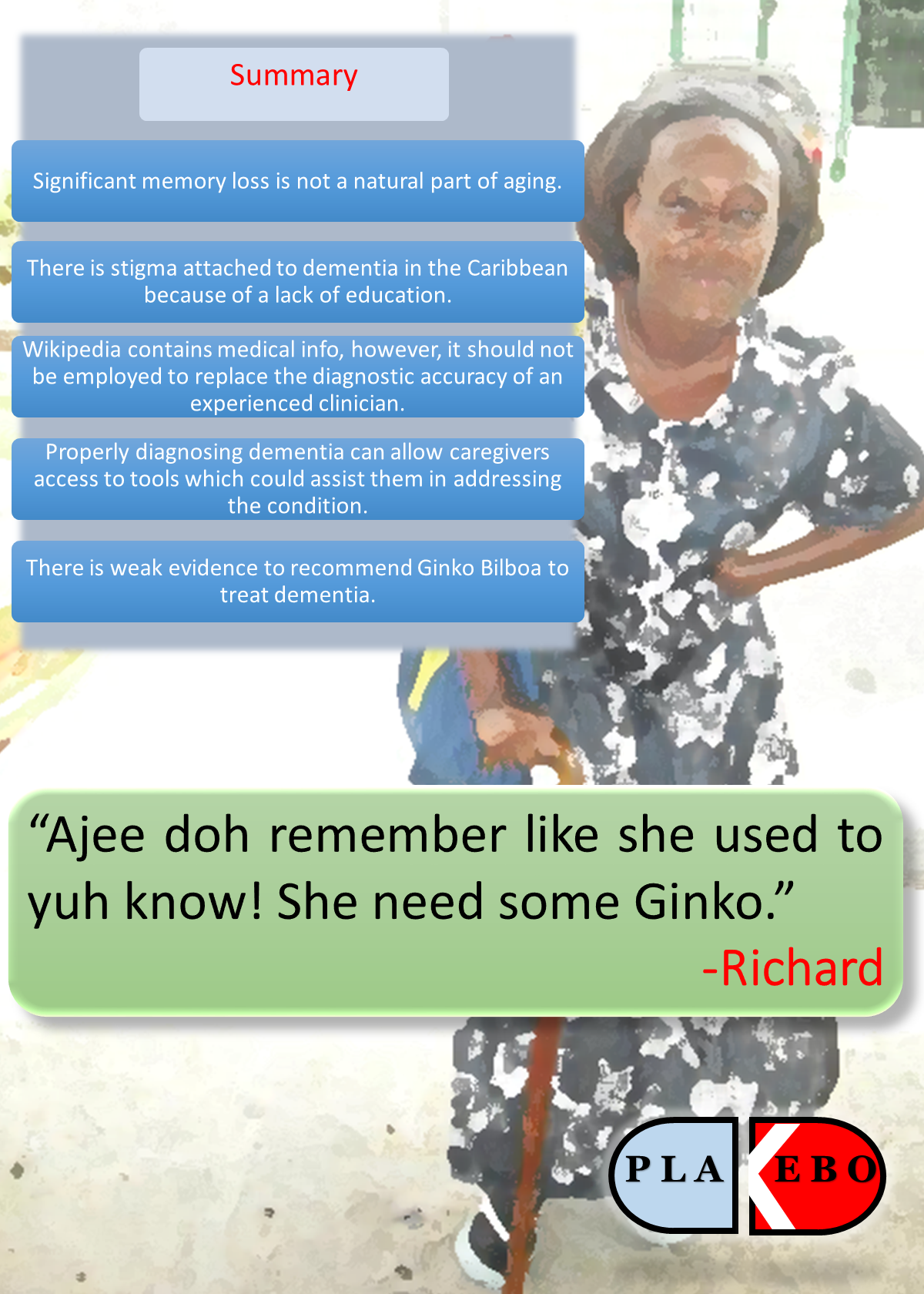
“Ajee doh remember like she used to yuh know!”
Case
Gladys, Richard’s grandmother, recently celebrated her 70th Birthday and over the past few years her family noticed that she has been forgetting little things. The last time Richard visited her he was surprised that she forgot to turn off the stove before she left the house and more recently, refused to let him in her house as she didn’t remember who he was. He went online, read Wikipedia and thought his granny had Alzheimer’s disease.
Summary
- Many senior citizens like Gladys have symptoms of dementia leaving their families confused and worried about their wellbeing.
- It is important to note that significant memory loss is not a natural part of aging.
- There is a great stigma attached to individuals who experience this mental illness in the Caribbean due to a lack of awareness about the condition.
- As a result, it is unclear the numbers of individuals suffering with dementia in many Caribbean countries.
- Websites such as Wikipedia may contain a large amount of medical information on various conditions including dementia, however, it should not be employed to replace the diagnostic accuracy of an experienced clinician.
- Properly diagnosing dementia can allow caregivers access to tools which could assist them in addressing the condition.
Raising public awareness and understanding of dementia.
The Caribbean may have one of the highest rates of persons with dementia in the world.(2.3) Alzheimer’s disease, is the main cause and involves brain cell destruction. Persons with this condition can slowly lose the ability to learn, remember and complete their daily activity. However, in the Caribbean, with the increasing number of persons with diabetes and high blood pressure, many experts believe vascular dementia (a special type) makes up a significant amount of dementia cases. Further, the number of persons over 60 years old in many countries in the Caribbean is expected to rise over the next decade. (1)
Causes
There are many theories which explore the development of the complex illness that is Alzheimer’s Disease, however, the exact cause still remains unclear.
Risk Factors
Senior citizens like Gladys who are over the age of sixty-five (65) years are at an increased risk of suffering from Alzheimer’s disease. But age is not the only factor that should be kept in mind. For instance, a serious traumatic brain injury, not spending a long time at school, obesity, smoking, depression, heart disease, family history of Alzheimer’s disease all increase the risk of getting dementia. (4)
Symptoms
The symptoms of the disease might be difficult to detect in the beginning since they are characterised by mild memory lapses. It is important to pay close attention to any relatives or friends who you may suspect to be suffering from the disease and recognise the the three stages of Alzheimer’s disease: (as listed above)
- Early: Memory loss, decreased understanding, or learning, but person is still able to function.
- Intermediate: Increased memory loss, changes in personality and increased dependence on others for basic needs.
- Severe: Loss of personality and bodily functions with total dependence on others for care.
Management
Caring for someone with dementia in the Caribbean can be difficult and is a complex issue which usually requires assistance from many different health specialties.(5) Seeking medical advice early on in the illness can help prepare Galdys’ family for things which they had not yet thought about such as, whether Gladys still has the ability to make decisions about her health, whether it’s safe for her to drive, etc… In addition, doctors can suggest exercises, psychological and medical treatments to limit any Gladys’ mood changes.
There are some expensive medications which can help Gladys live a relatively normal life in the early stages of her illness and slow progession. Therefore it is important to speak to a doctor if you were concerned about your family members as they may be able to recommend a local geriatric psychiatrist or other help in your area which may help you better cope with caring for persons like Gladys. It must be noted that in the Caribbean, due to limited dementia awareness, management options are limited.(4)
Ginko Bilboa: a placebo effect?
Ginkgo biloba is safe with no side effects. However, research into it has “used unsatisfactory methods, were small, and publication bias cannot be excluded.” Therefore it is not recommended it to treat dementia.(6)
Conclusion
Over the past decade there have been a significant amount of research programmes into the condition in countries like Trinidad and Tobago and Jamaica, however, there is still a great need for awareness in the Caribbean. Partnerships between Universities and Government institutions are likely to improve the quality of care for persons like Gladys suffering from all forms of Dementia.
Further information could be on Alzheimer’s found at: Link 1 or Link 2
References
(1) Baboolal, Nelleen, Gershwin Davis, and Amanda McRae. “Trinidad and Tobago.”
(2) Alzheimer’s Disease International (2009). World Alzheimer Report 2009. M. Prince and J. Jackson. London, Alzheimer’s Disease International
(3) The prevalence and associated demographic factors of dementia from a cross-sectional community survey in Kingston, Jamaica
(4) Villars, Hea, et al. “The primary care physician and Alzheimer’s disease: an international position paper.” The journal of nutrition, health & aging 14.2 (2010): 110-120.
(5) Pusey-Murray, Andrea, and Paul Miller. “‘I need help’: caregivers’ experiences of caring for their relatives with mental illness in Jamaica.” Mental health in family medicine 10.2 (2013): 113.
(6) Birks, Jacqueline, and John Grimley Evans. “Ginkgo biloba for cognitive impairment and dementia.” The Cochrane Library (2009).
(5) Pusey-Murray, Andrea, and Paul Miller. “‘I need help’: caregivers’ experiences of caring for their relatives with mental illness in Jamaica.” Mental health in family medicine 10.2 (2013): 113.
(6) Birks, Jacqueline, and John Grimley Evans. “Ginkgo biloba for cognitive impairment and dementia.” The Cochrane Library (2009).
Leave a Reply